
Research at BioZone spans many disciplines within industrial and environmental biotechnology. Most of our projects focus on anaerobic microbial technology and conversion of waste and biomass residuals to valuable materials and chemicals.
Read more about our biggest research projects below.

Bioremediation of contaminated groundwater
Decades of industrial activity at sites around the world have left a troubling legacy of soil contamination. Many industrial pollutants are mobile, and spread from the initial site of use to cover vast areas, eventually finding their way into groundwater.
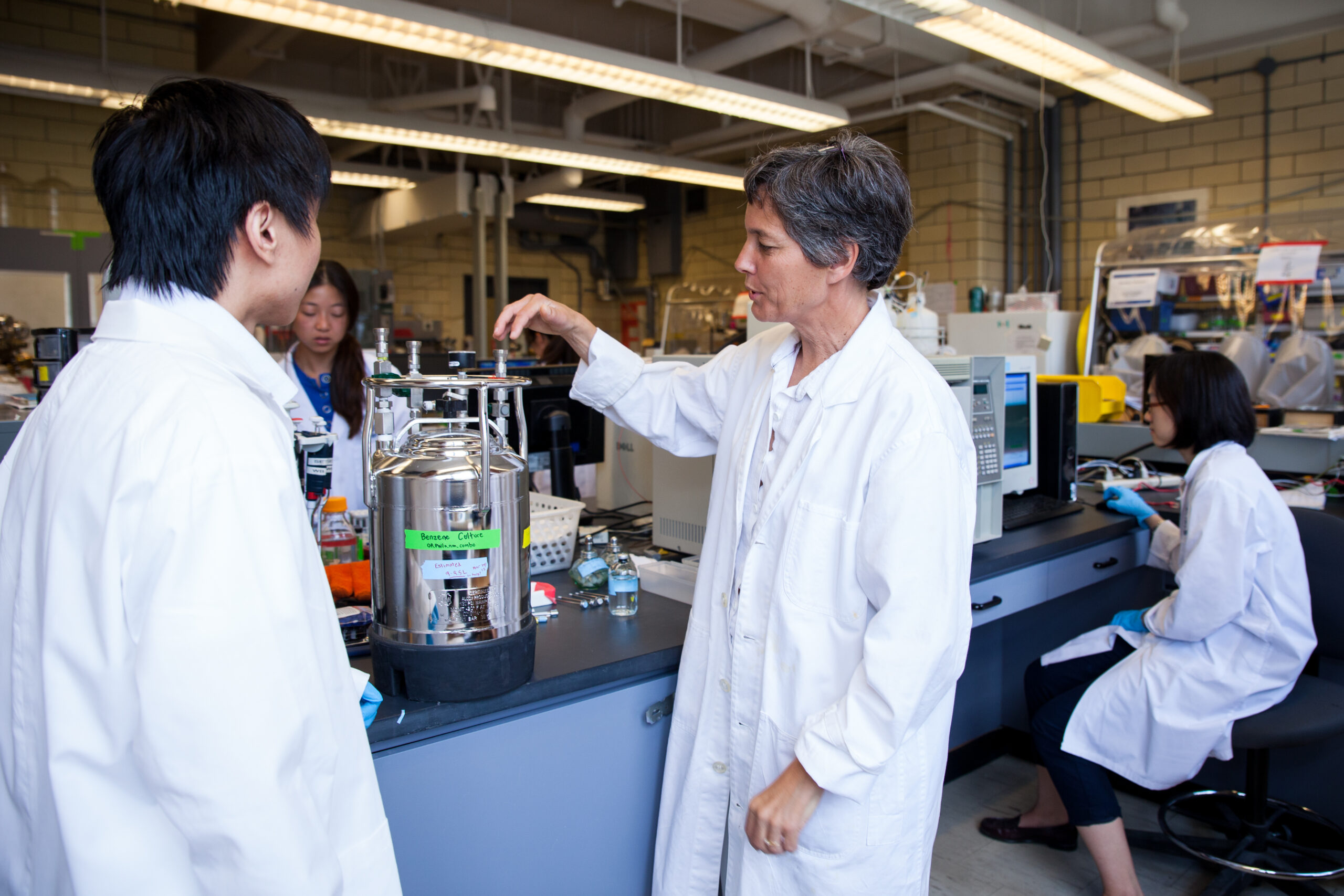
BioZone Principal Investigator Elizabeth Edwards has devoted her career to exploring and understanding how microbes can be used to decontaminate groundwater. Her group develops and studies microbial cultures for bioaugmentation - the practice of supplementing naturally occurring microbes that "eat" pollutants.
Work in Edwards' lab resulted in the development of KB-1, a bioaugmentation culture that has been used at hundreds of sites polluted with chlorinated solvents. Her team is now working with SiREM - a Guelph-based company she co-founded - to apply this concept to benzene and toluene, two other problematic pollutants. This Genome Canada-funded project, in partnership with Imperial Oil and Federated Co-op, is now testing this "benzene-eating" microbial culture at a site near Toronto.
Microbial biomining from nickel tailings
The electric-vehicle industry relies on a supply of critical minerals, including nickel, that are used in batteries and other vehicle components. Ontario is one of the world's top nickel-producing regions, and a century of mining activity in the Sudbury area has resulted in an estimated 100 million dry metric tonnes of pyrrhotite (iron sulfide) tailings containing residual nickel - worth over USD$13B - at concentrations too low to be exploited by conventional means. These tailings must be stored under water to prevent them from becoming environmentally hazardous.
BioZone Principal Investigators Krishna Mahadevan and Elizabeth Edwards, along with Associate PI Vlad Papangelakis, are partnering with Canadian and international mining firms to develop microbial strains that dissolve pyrrhotite tailings, freeing up nickel for hydrometallurgical processing. This project, named NiMBLE, is re-engineering the metabolism of acid-tolerant microbes to make them more tolerant to high concentrations of metal and less capable of generating toxic acidic byproducts.
NiMBLE partners will use their experience in mining process engineering to scale up and apply the improved bioleaching process to tailings already present in the Sudbury basin.

Double-fortified salt for developing countries
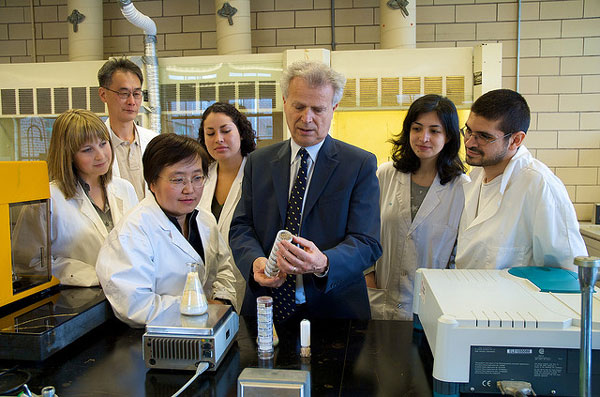
In the early 2000s, BioZone Principal Investigator Levente Diosady received a small grant from the Micronutrient Initiative (MI), a Canadian not-for-profit organization devoted to eliminating micronutrient deficiencies in the developing world. The MI was looking for creative ways to tackle iron and iodine deficiencies that are common among rural populations in India, and Diosady set out to find ways to fortify salt - one of the very few food ingredients that are not produced locally in those communities - with both of these minerals.
Diosady's group developed technology to encapsulate the ferrous fumarate, a common, orange-coloured iron supplement, with an opaque white coating that would both allow it to blend in with salt crystals. The result is a shelf-stable, double-fortified salt that addresses both mineral deficiencies in one easy-to-use product.
A pilot study in the Indian state of Tamil Nadu revealed that schoolchildren eating lunches cooked with the double-fortified salt had 34% lower rates of anemia. Diosady and his colleagues have followed up these results with an expanded study of over 50 million people in the state of Uttar Pradesh, who now receive double-fortified salt through the national food distribution system, greatly reducing anemia rates in this population at a cost of about 25 cents per person per year.
Further projects in Diosady's lab are exploring ways to expand the fortification of salt - as well as other staples such as tea and bouillion cubes - with additional micronutrients such as Vitamin B12, folic acid, and zinc.
Extracting value from biomass residues
The forestry and agricultural sectors are major contributors to Canada's economy, accounting for tens of billions of dollars of economic activity each year. Besides primary forest products and food, corresponding processes generate over 100 million tonnes of residues per year, providing sustainably sourced resource for renewable chemical and material manufacturing.
BioZone Principal Investigator and Academic Director Emma Master and her research group are using protein engineering to transform these underutilized biomass residues into valuable chemicals and materials. Their focus on cell-free enzyme technologies that upgrade rather than degrade renewable biomass provides resource-efficient options for residue valorization. Example approaches include manipulating carbohydrate-active enzymes to convert underused hemicelluloses to glucaric acid, bio-based crosslinkers, and polyamines, and developing expansin-related proteins for cellulose processing, providing bio-based alternatives to synthetic substances in resins, textiles and composite materials.

Waste-to-chemicals via anaerobic communities
Anaerobic digestion (AD) uses microbes to convert organic matter -- usually food and agricultural waste -- into renewable, non-fossil-derived natural gas (RNG) that can be fed into the natural gas distribution system. A typical AD reactor is home to dozens or even hundreds of microbial strains, forming a large interconnected network of organisms that play distinctive roles in the conversion of carbohydrate materials into methane.
BioZone Principal Investigator Chris Lawson is re-envisioning AD to create even higher-value products. By analyzing the role that each microbial strain plays in mixed anaerobic microbial communities, his research group is engineering bottom-up approaches to create medium-chain fatty acids, an important set of chemicals used in a variety of industries. The microbes Lawson's group uses grown on wastewater, providing a nearly free source of carbon for this environmentally friendly process. Lawson's research is supported by NSERC, in partnership with Veolia.
A sea of signals: chemical ecology in marine microbial communities
Natural microbial communities have an enormous impact on the planet and environment, as drivers of global biogeochemical processes such as carbon and nitrogen cycling. Due to recent advances in genomics and mass spectrometry, we have more data than ever about microbial biology and chemistry. However, translating these findings to complex microbial communities lags behind-how do individual microbes and metabolites interact to determine community function and ecology?
The new Microbial Chemical Ecology (MicroChemEco) Lab, established in March 2025 by BioZone Principal Investigator Rachel Gregor, aims to understand and engineer microbial communities through their chemistry. We focus on bacterial communities in the surface oceans that play a key role in the marine carbon cycle. Using untargeted metabolomics, we study the community functions of specialized metabolites, including antibiotics, signal molecules, and novel natural products. Understanding the chemical forces that regulate microbial communities will enable us to engineer microbial products for health, environmental, and industrial applications, and expedite the discovery of new microbial chemistry.
