
Joining the Conversation in Microbial Ecology and Evolution
"Microbial ecology and evolution research is diverse and international." - Ariel Tastassa
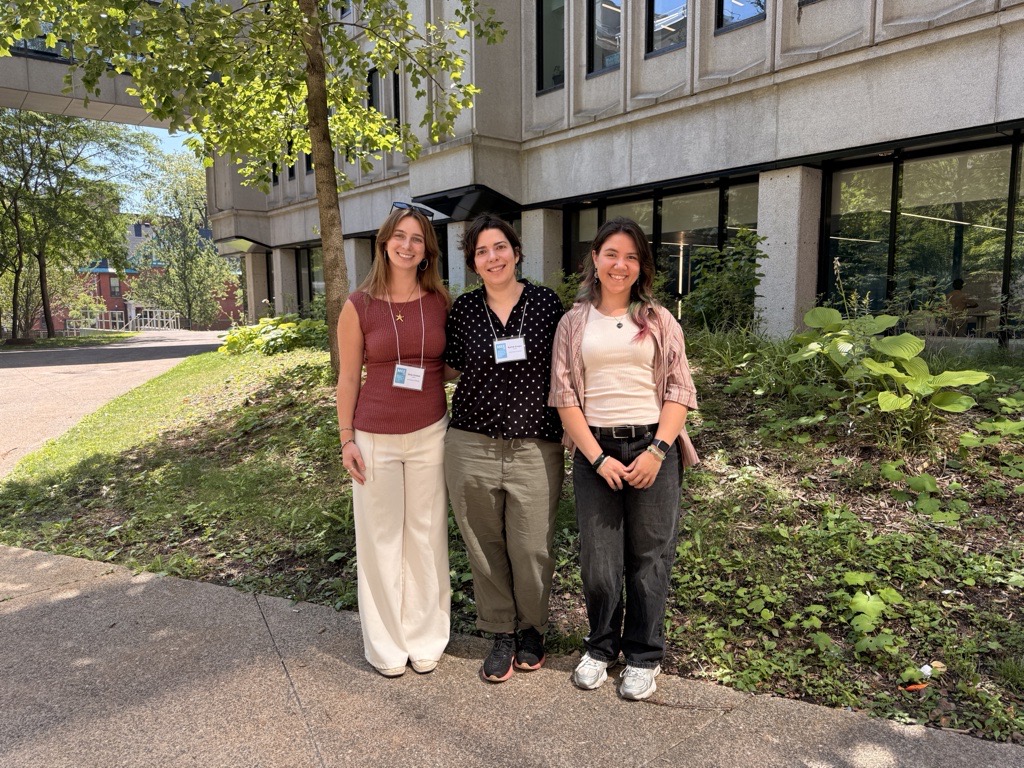
This past August, Dr. Rachel Gregor, Assistant Professor in BioZone and the Department of Chemical Engineering and Applied Chemistry, joined trainees Ariel Tastassa, Shilo Chislett, and Bianca Wozniak at the three-day Microbial Ecology and Evolution Hubs (MEEHubs2026) conference in Montreal.
MEEHubs2026 featured a unique hybrid format, with seven hubs hosted around the world—from Mexico to Switzerland—alongside a virtual hub. This model enabled researchers to participate remotely while connecting through local, in-person gatherings.
Professor Gregor’s research examines how individual microbes and metabolites interact to shape community function and ecology, making the conference particularly relevant to her work. Having attended the Boston hub in 2024, she returned this year as part of the organizing team for the Canada East Hub.
“It’s a really creative format to minimize travel and make international conferences more accessible, while still fostering the broad exchange of ideas,” says Gregor. “This is the first time a hub has been hosted in Canada.”
The conference also provided Professor Gregor with the opportunity to bring trainees Bianca and Shilo to Montreal and expose them to research perspectives beyond their usual academic environments.
“It was particularly interesting to see how presentation styles and research areas differed across countries,” she explains. “I hope it exposed them to some systems and concepts we don’t usually think about in our own research and sparked some new ideas.”
Beyond sharing research, the conference highlighted diverse approaches to scientific inquiry. “It was striking to me that despite the impact of cutting-edge technologies like ‘omics, microfluidics, and single-cell analysis, some of the most elegant data still comes from traditional, ‘low-tech’ experiments, like bacterial competition assays on plates,” says Gregor. “It’s a great reminder to always ask what the simplest way is to start examining a hypothesis.”
The conference also provided opportunities for Ariel and Shilo to present their research. Shilo, a Master’s of Engineering student in Professor Gregor’s Lab, presented her work, “Quorum sensing regulates chitin degradation in marine snow bacterial communities.” She shared, “I left this conference feeling more grounded in my own research. It was exciting to see the wide range of approaches being used to study microbial ecology and evolution, and to consider how some of these perspectives could inform my own work.”
Ariel, a third-year Ph.D. student supervised by Professor Elizabeth Edwards and co-supervised by Laura Hug, an Associate Professor at the University of Waterloo and BioZone alumna, presented “Identification of novel multicopper oxidases through screening functional metagenomic libraries.” Ariel adds, “It was fantastic to be at the Montreal hub and get to engage with international research(ers)! I made a connection with a professor at McGill and a Ph.D. student at ETH (Zurich). I hope to see many conferences adopt this hybrid and eco-friendly format!”
“Microbial ecology and evolution research is diverse and international. There are benefits to being in the same room and engaging through virtual connections. This conference made the best of both worlds!” says Ariel.
By Miguel Roberto Tsai & Bethany Chan
Posted September 30, 2026